Debt vs Equity Financing: Which Is Better for Business Expansion in India?
Published on 6/9/2026
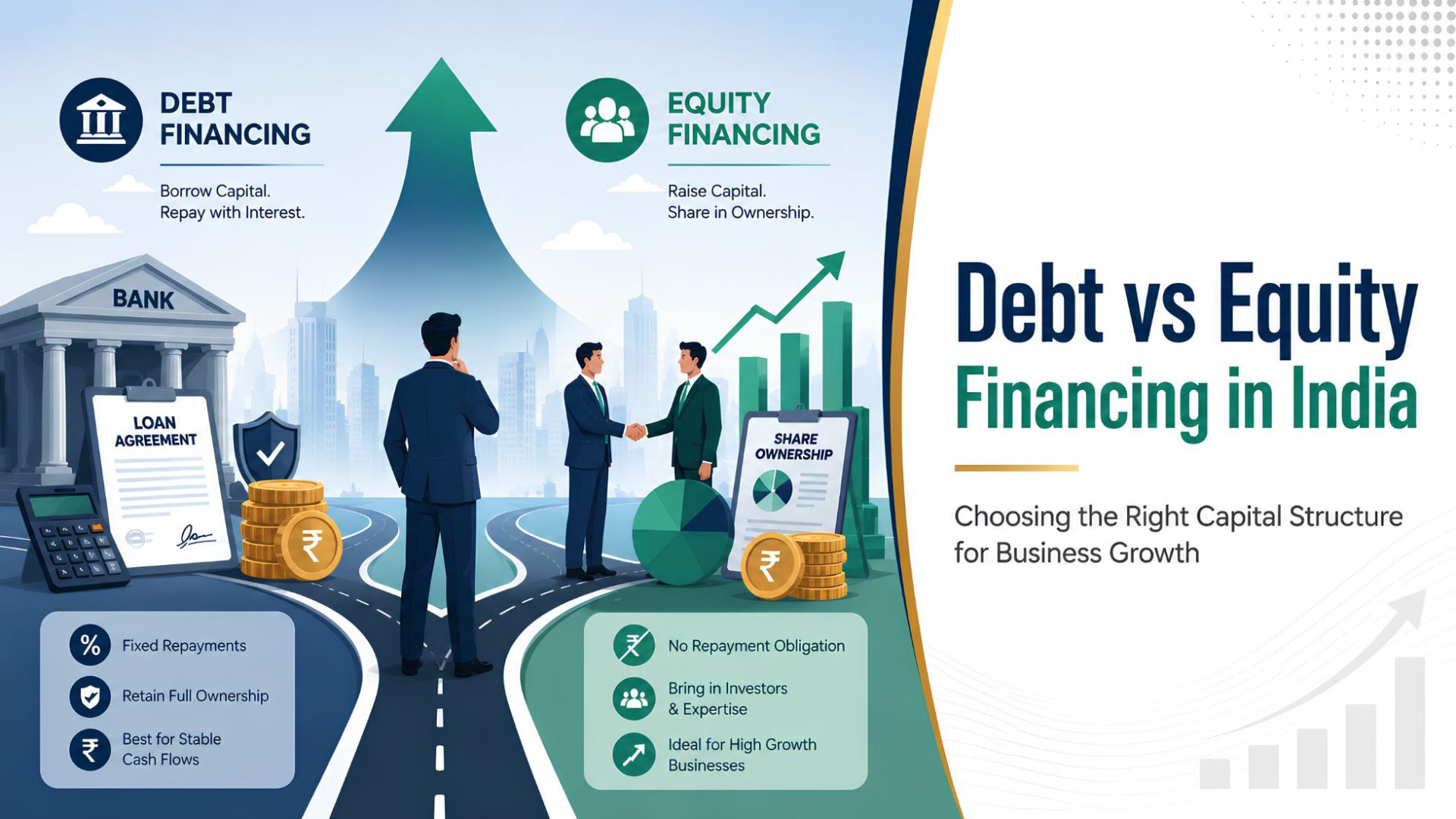
Debt vs equity financing in India refers to the choice businesses face when raising capital — borrowing money (debt) which must be repaid with interest, or giving up a share of ownership (equity) in exchange for capital. The right choice depends on your business stage, growth plan, cash flows, and risk appetite. Most growing businesses in India ultimately use a combination of both.
Every business reaches a point where internal cash flows aren’t enough to fund the next phase of growth. A factory expansion, a new product line, a market entry — these require capital beyond what the business generates organically.
Two paths exist. You borrow the money and pay it back. Or you bring in investors and give them a piece of the company. Both have worked for some of the most successful businesses in India. Both have also caused serious problems when chosen for the wrong reasons.
This isn’t a question with a universal answer. But there are clear frameworks to help you think through it.
Strong Bank Credit Growth
Robust Equity Fundraising Activity
Both
- What Is Debt Financing for Businesses in India?
- What Is Equity Financing for Startups and Growth Businesses?
- Capital Structure Advisory — Why the Mix Matters
- Debt vs Equity: Key Differences (Table)
- 5 Factors That Drive the Financing Decision
- Hybrid Instruments — The Middle Ground
- Role of Capital Structure Advisory in India
- Frequently Asked Questions
🏦 What Is Debt Financing for Businesses in India?
Debt financing means raising capital by borrowing from banks, NBFCs, debenture holders, or through instruments like external commercial borrowings (ECBs).
The key feature: you repay the principal plus interest, but you keep full ownership.
- Term loans from scheduled commercial banks
- Working capital loans from banks and NBFCs
- Non-convertible debentures (NCDs) for institutional investors
- External Commercial Borrowings (ECBs) under RBI guidelines
- Invoice discounting and supply chain financing
- Predictable, stable cash flows (manufacturing, real estate, infra)
- You want to retain full ownership and control
- Capital needed for a specific, time-bound purpose
- Interest rates are favourable relative to expected ROI
- High leverage in unpredictable revenue environments
- Heavy debt servicing constrains reinvestment capacity
- Collateral requirements limit access for asset-light businesses
📈 What Is Equity Financing for Startups and Growth Businesses in India?
Equity financing means raising capital by selling a stake in your company to angel investors, venture capitalists, private equity funds, or the public (via an IPO).
No repayment obligation. No interest cost. But you share ownership, profits, and decision-making.
- Angel investment for early-stage startups
- Venture capital — Series A and beyond
- Private equity for mid-market and growth-stage businesses
- Alternate Investment Funds (AIFs) — Category I, II, and III
- Public equity markets via SME IPOs or Mainboard IPOs
📊 Market Data
Indian capital markets have witnessed strong equity fundraising activity in recent years, reflecting growing investor confidence and increasing access to growth capital for businesses.
- High-growth phase where returns exceed debt costs
- Cash flows are insufficient to service debt comfortably
- Capital-intensive sectors with long growth runways
- Strategic investors bring networks, expertise, and market access
- Ownership dilution is permanent (until you buy back)
- Investor expectations around governance and exit timelines
- Misalignment between founders and investors creates friction
⚖️ Capital Structure Advisory India — Why the Mix Matters More Than the Choice
Most businesses don’t choose between debt and equity in isolation. They manage a capital structure — the ongoing mix of both — and getting that mix right is one of the most consequential financial decisions a business will make.
Creates fragility. One bad quarter can trigger covenant breaches and lender conversations you don’t want to have.
You’ve given away ownership that compounds in value. A 20% dilution at ₹50 Cr valuation looks very different when the company is worth ₹500 Cr five years later.
This is where capital structure advisory in India earns its keep. Advisors model out the cost of different capital structures, stress-test them against revenue scenarios, and help businesses choose instruments that match their specific risk profile and growth plan.
📊 Debt vs Equity Financing India: Key Differences Explained
Before choosing between debt and equity financing in India, compare both options side by side across ownership, repayment, cost, and suitability.
| Factor | Debt Financing | Equity Financing |
|---|---|---|
| Ownership | Promoters retain full ownership | Ownership is diluted |
| Repayment | Principal + interest must be repaid | No repayment obligation |
| Cost | Interest expense | Dilution of future value |
| Risk | Higher financial risk — fixed repayments | Lower cash flow pressure |
| Control | Founders retain full decision-making | Investors may influence decisions |
| Suitable For | Mature businesses with stable cash flows | Startups and high-growth companies |
| Collateral | Often required by lenders | Not required |
| Examples | Bank loans, NCDs, ECBs | Angel funding, VC, PE, IPOs |
🧩 5 Factors That Drive the Debt vs Equity Financing Decision in India
There’s no formula, but these five factors should drive every capital structure decision:
Revenue Predictability and Business Expansion Funding India
If your revenue is relatively predictable and recurring, you can service debt. If it’s lumpy or stage-dependent, equity gives you breathing room.
Business Stage — Startup or Established?
Early-stage businesses with no profitability typically can’t access debt capital at reasonable rates. Equity financing for startups is often the only realistic path.
Asset Base and Collateral Availability
Banks and NBFCs lend against assets. If you’re asset-light (tech, services), you may not qualify for significant debt without personal guarantees or collateral substitutes.
Promoter Dilution Tolerance
Some founders are deeply uncomfortable with outside investors having board seats or information rights. That preference should factor into the decision — though it shouldn’t override financial logic.
Existing Leverage
If your debt-to-equity ratio is already elevated, adding more debt increases bankruptcy risk. Equity may be the only practical option, even if dilution is uncomfortable.
🔀 Hybrid Instruments — The Middle Ground in Investment Banking Capital Structure
Not every financing decision is binary. India’s capital markets offer several instruments that blend characteristics of both debt and equity:
Issued as debt, mandatorily convert into equity at a future date. Common in PE and VC deals.
The investor can choose to convert into equity or redeem as debt at maturity.
Fixed dividend, limited voting rights — less dilutive than equity, but safer than pure debt.
A hybrid layer between senior debt and equity. Common in buyout and leveraged structures.
For growing Indian businesses, hybrid instruments often solve the trade-off elegantly — especially when there’s near-term cash flow uncertainty but significant long-term equity upside.
🎯 Role of Capital Structure Advisory India in Making the Right Financing Decision
This is where businesses often make their most expensive mistakes: deciding on capital structure without professional advisory support. An investment banking advisor brings three things to this decision:
Not just the headline rate — but total capital cost including opportunity cost of dilution, refinancing risk, and covenant implications.
Debt pricing, PE return expectations, AIF eligibility criteria — these change. What was optimal 18 months ago may not be optimal today.
The best terms in any market go to well-prepared companies with good advisors. You get access to capital sources you wouldn’t find alone.
Inspirigence Advisors works with businesses across funding stages to design capital structures that balance growth ambition with financial resilience. Whether you’re weighing a PE round against a bank term loan, or structuring a pre-IPO raise alongside existing debentures, having the right investment banking advisory guidance at this decision point matters enormously.
❓ Frequently Asked Questions
- Debt and equity are tools — neither is inherently better. The right fit depends on your stage, cash flows, and risk profile.
- Most growing businesses use a combination of both — it’s about managing the capital structure, not making a one-time binary choice.
- Hybrid instruments like CCDs, OCDs, and preference shares offer a middle ground when debt or equity alone doesn’t fit cleanly.
- The businesses that make consistently good capital structure decisions treat it as a strategic exercise, not a reactive one.
- Engaging an experienced investment banking advisor early is the highest-ROI decision before any significant capital raise begins.
Planning a Capital Raise?
Whether debt, equity, or hybrid — Inspirigence Advisors helps you design and execute the right capital structure for your growth stage.
Read More:-