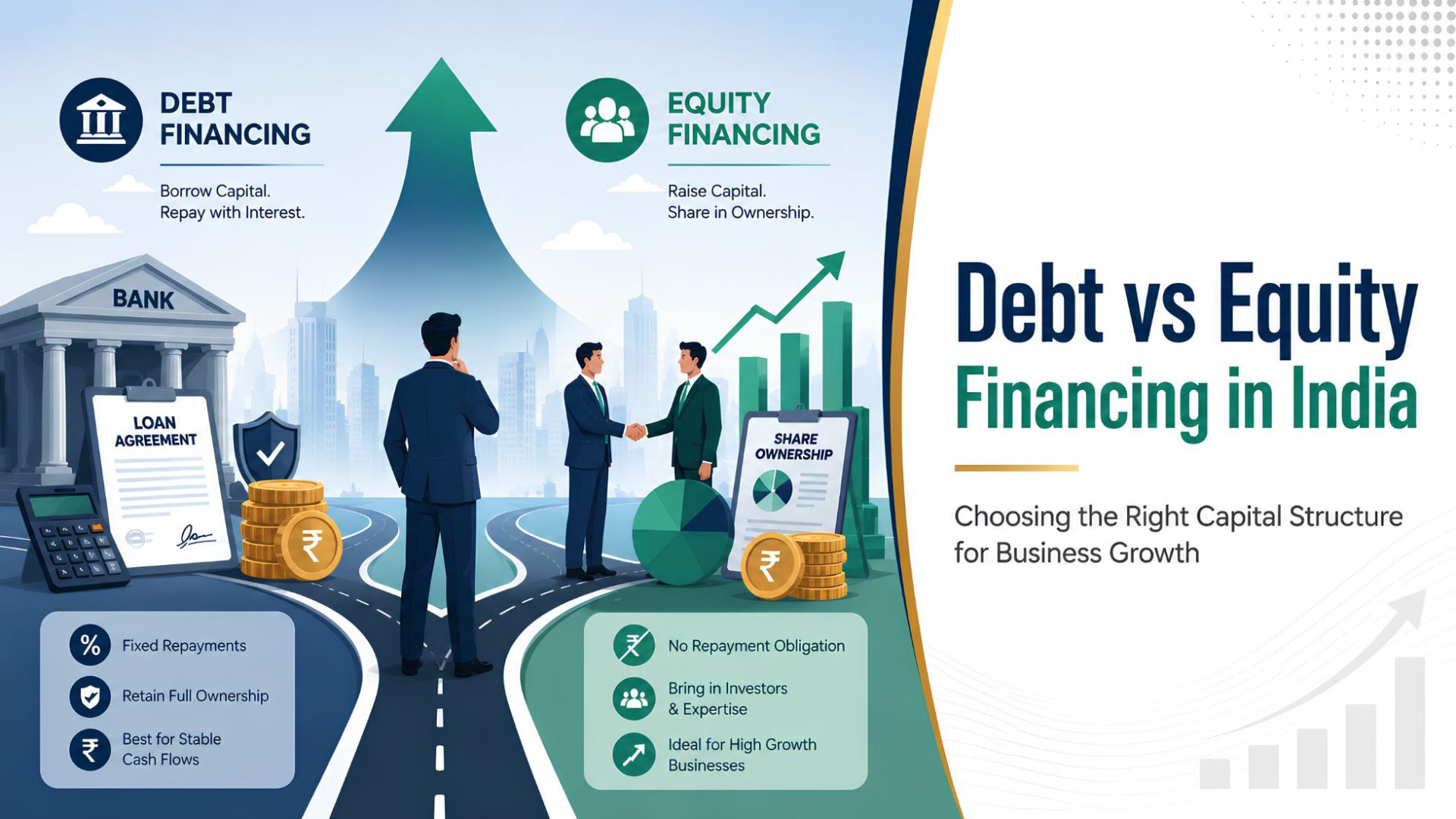
How to Value Your Business Before Approaching an Investment Banker in India
Published on 6/11/2026
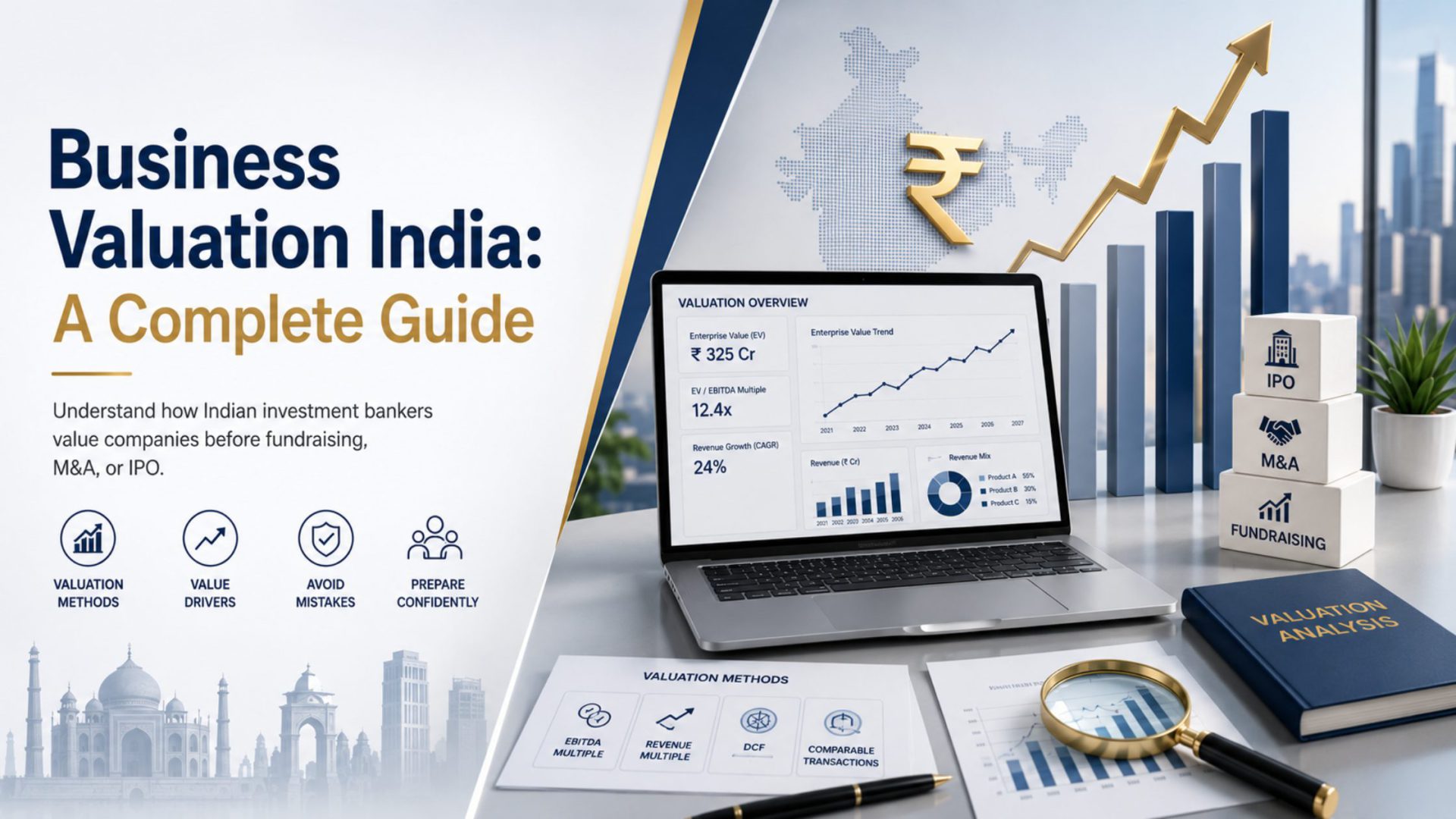
Business Valuation India: A Complete Guide
Understand the valuation methods Indian investment bankers actually use — before any fundraise, M&A, or IPO.
By Inspirigence Advisors · 7 min read · Updated June 2026
The article in 60 seconds
A practical guide to how investment bankers in India value a business — and how to walk into the room prepared. It explains the four valuation methods that dominate Indian deals, the factors that actually move your multiple, the mistakes that trigger valuation cuts in due diligence, and what to have ready before a fundraise, M&A, or IPO.
KEY POINTS
- ▸Four methods dominate in India: EBITDA multiple, revenue multiple, DCF, and comparable transactions.
- ▸EBITDA multiples vary sharply by sector — roughly 12–20x for tech vs 5–10x for manufacturing.
- ▸The biggest multiple-movers are recurring revenue, margin trajectory, and customer concentration.
- ▸Clean financials and the right timing in your valuation cycle can be worth crores.
📍 QUICK ANSWER
Business valuation in India means determining the economic worth of a company using financial metrics, market comparables, and future earning potential. Before approaching an investment banker in India for fundraising, M&A, or an IPO, understanding your business’s valuation gives you a realistic foundation for negotiations, helps you identify value gaps to fix, and ensures you walk into investor conversations with credibility — not just optimism.
There’s a conversation that happens frequently between investment bankers and business owners. The owner says, “I think we’re worth ₹500 crore.” The banker runs the numbers. The number comes back at ₹200 crore.
“I think we’re worth ₹500 crore.”
The banker runs the numbers — and the answer comes back at ₹200 crore.
That gap — between what founders believe their business is worth and what the market will pay — is one of the most common and costly surprises in corporate finance. And in most cases, it’s entirely avoidable.
Understanding how your business is likely to be valued before you enter the market isn’t just useful. It’s essential preparation for any serious fundraising or sales process.
📋 ON THIS PAGE
1. Why valuation matters before you hire a banker
2. Core valuation methods Indian bankers use
3. Key value drivers that move your multiple
4. Common mistakes that reduce valuation
5. How to prepare for your first meeting
💼 Why Business Valuation Matters Before Hiring an Investment Banker
A good team of investment banking advisors exists to position your business optimally in the market and extract the best possible value from a transaction. But they can only work with what you give them.
If your financials have inconsistencies, your EBITDA margins are compressed by related-party transactions, or your growth story isn’t well-documented, these are problems that will surface in due diligence regardless of how well the banker pitches you. Smart investors will find them.
Getting a pre-engagement business valuation assessment does several things:
- ▸It sets realistic expectations before you enter any negotiation
- ▸It identifies specific value gaps you can close before going to market
- ▸It helps you choose the right transaction type (PE raise vs. strategic sale vs. IPO)
- ▸It tells you when not to go to market — which can be the most valuable insight of all
💡 Timing is a value driver in itself. A business worth ₹300 crore in a flat revenue year might be worth ₹500 crore two years later after demonstrating a growth trajectory. When you approach the market should be informed by where you are in your valuation cycle.
📊 Core Business Valuation Methods India — What Investment Bankers Use
There’s no single “correct” method for business valuation in India. Different methods suit different business types, stages, and transaction contexts. In India’s capital markets, four methods dominate.
1. EBITDA Multiple — The Most Common Business Valuation Method in India
This is the most commonly used method for mid-market and profitable businesses.
The multiple varies by sector. Indicative ranges seen in the Indian market:
| Sector | Typical EV/EBITDA Multiple |
|---|---|
| Technology & Software Services | 12–20x |
| Manufacturing | 5–10x |
| Consumer Retail | 8–15x |
For this method to be meaningful, your EBITDA needs to be clean — free of one-time items, related-party distortions, and accounting anomalies.
2. Revenue Multiple — Used in Company Valuation for Fundraising at Early Stages
Used primarily for high-growth companies that are not yet profitable — common in SaaS, fintech, and consumer internet. A ₹50 crore ARR SaaS company growing at 80% YoY might command a 6–8x revenue multiple from the right investor, even with thin margins. Revenue multiples are more subjective and depend heavily on growth rate, market size, and competitive positioning.
3. DCF — Discounted Cash Flow in Business Valuation Methods India
DCF values a business based on the present value of its future free cash flows, discounted at an appropriate rate (usually WACC — Weighted Average Cost of Capital). It’s theoretically rigorous but practically sensitive to assumptions: small changes in the discount rate or terminal growth rate can move valuations dramatically. DCF is best used as a cross-check against market multiples, not as a standalone primary method.
4. Comparable Transactions — How to Value a Company Before IPO Using Market Evidence
Looking at what similar companies were sold or listed at in recent deals, particularly relevant in India’s active market for M&A advisory. If three similar logistics companies were acquired at 8–10x EBITDA in the last 18 months, that creates a market reference point for any new transaction in the same space. Bankers use precedent transactions extensively to anchor valuation arguments with potential buyers.
The four methods at a glance
| Method | Best Suited For | What It’s Based On |
|---|---|---|
| EBITDA Multiple | Profitable mid-market businesses | EBITDA × sector multiple |
| Revenue Multiple | High-growth, pre-profit firms (SaaS, fintech) | Revenue × growth-based multiple |
| DCF | Cross-checking other methods | Present value of future cash flows |
| Comparable Transactions | Sectors with active M&A | Pricing of similar recent deals |
📈 Key Value Drivers That Affect Company Valuation for Fundraising in India
Knowing the method is one thing. Understanding what moves the multiple is what actually helps you increase value before going to market.
Revenue Quality and Recurring Income
Recurring, contractual revenue commands a higher multiple than transactional or project-based revenue. Shifting your model toward recurring revenue directly impacts business valuation in India.
EBITDA Margin Trajectory
Investors don’t just care about current margin — they care about direction. A business with 12% margins expanding to 18% is more compelling than one with stable 20% margins and no growth.
Customer Concentration Risk
If 60% of your revenue comes from one or two clients, expect investors to apply a discount. Diversifying your customer base before going to market can materially improve your company’s valuation for fundraising.
Management Depth and Second-Line Leadership
In smaller businesses, if the promoter is the business, that’s a risk investors price in. Building a second line of management adds measurable value in any pre-fundraise business assessment.
Documentation and Compliance Hygiene
Clean audited accounts, no pending litigation, GST compliance, proper employment contracts, IP registered in the company’s name. Their absence is frequently used to justify valuation haircuts in due diligence.
⚠️ Common Mistakes That Reduce Business Valuation in India
Some of these are controllable; some take time to fix. All are better identified before approaching an investment banker in India.
⚠️ Related-party transactions at non-market prices: These show up in due diligence and create a credibility problem that’s hard to recover from.
⚠️ Inconsistent accounting policies: Companies that switch accounting policies across years face significant buyer scrutiny.
⚠️ Undisclosed liabilities: Contingent tax liabilities, pending regulatory penalties, or undisclosed guarantees — discovered in due diligence, they almost always result in valuation adjustments.
⚠️ Overestimated synergies: If you’re selling to a strategic buyer, keep synergy claims realistic and quantifiable. Buyers discount aggressive synergy claims heavily.
📝 Pre-Fundraise Business Assessment — How to Prepare Before Your First Meeting
When you first meet an investment banker in India, they’ll look at your business through a specific lens. Having the following ready dramatically improves that first conversation.
📋 Have these ready before your first meeting
- ✓3 years of audited financial statements (P&L, balance sheet, cash flow)
- ✓Management accounts for the current year (more current than the annual audit)
- ✓Revenue breakdown by customer, product, and geography
- ✓EBITDA bridge showing adjustments for one-time items
- ✓Headcount and organisational structure
- ✓Key customer contracts (tenure, renewal terms, exclusivity)
- ✓IP, licenses, and regulatory certifications
- ✓Cap table and ownership structure
You don’t need a formal valuation report to start the conversation. But walking in without any of this is like applying for a loan without bank statements — it slows everything down and signals unpreparedness.
💸 How to Value a Company Before IPO — What Changes in the Public Market Context
The IPO context shifts business valuation in India in specific ways:
- ▸SEBI’s ICDR regulations require a minimum track record of profitability or specific financial metrics, depending on the listing segment (Mainboard vs. SME)
- ▸EV/EBITDA and P/E multiples from comparable listed companies become the primary benchmark
- ▸Book-building and price discovery replace private negotiation — the market sets the price within a band
- ▸Pre-IPO funding rounds within 18 months of listing get scrutiny from SEBI on pricing
- ▸Promoter lock-in requirements and ESOP structures become valuation-relevant
💡 Why this matters: the valuation you negotiate in the last private round before listing often becomes the anchor for IPO pricing. Getting it right — not too high (creating downside pressure post-listing) and not too low (leaving money on the table) — is an art that experienced IPO advisory teams understand well.
❓ Frequently Asked Questions
✅ Key Takeaways
- ✓Know your realistic value range — and the methodology behind it — before you enter the market.
- ✓Close the value gaps you can control: margin trajectory, customer concentration, and documentation hygiene.
- ✓Timing matters — where you are in your valuation cycle can be worth crores.
- ✓The banker positions you, but can only work with a business that’s ready for scrutiny.
That groundwork — done before the negotiation room — is where deals are won or lost.
Planning a fundraiser, sale, or IPO?
Inspirigence Advisors helps businesses get transaction-ready — assessing pre-fundraise readiness, closing the gaps that affect investor perception, and building the financial narrative that supports the best possible outcome.
Read More:-